Mini Split Installation in Sundance, WY
A new system here will heat from September through June and cool from July through August every year. Tell us about the house, and a licensed contractor who covers Crook County will get in touch.
Tell us about the job
It takes about a minute.
Sundance asks a mini-split to run nearly all year
Ten months out of twelve, your mini-split is the thing keeping the house livable. Heat runs September through June, with winter nights averaging 12°F from December through February. Cooling only kicks in for July and August, when afternoons average 82°F, but that leaves just two months where the unit gets a break.
A new mini-split installed here has to hold up against real cold, not mild chill. Any unit manufactured from 2023 on has to meet 7.5 HSPF2 for heating and 14.3 SEER2 for cooling, and in Sundance the heating side of that rating matters more, since the compressor will spend most of its life pulling heat out of 12°F air. Crook County also sees its share of winter storms and wind, and outages do happen. Most mini-splits come back on by themselves once power returns, so that part takes care of itself.
- 10 months
- September through June, your system heats
- 2 months
- July through August, it cools
- 12°F
- the average winter night it heats against
- 82°F
- the average summer afternoon it cools against
NOAA nClimDiv, 1991–2020 normals
- Is a mini split worth it?
- For most homes here, yes, especially if you're heating a room that's hard to keep warm or cooling one that gets stuffy in July and August. A mini split puts heat right where you need it without ductwork, and it keeps working efficiently even when the number on the thermostat is a stretch for other systems. With winter lows around 12°F, look for a cold-climate model rated to perform down to that range, since not every heat pump is built for it.
- How many rooms can a mini split cover?
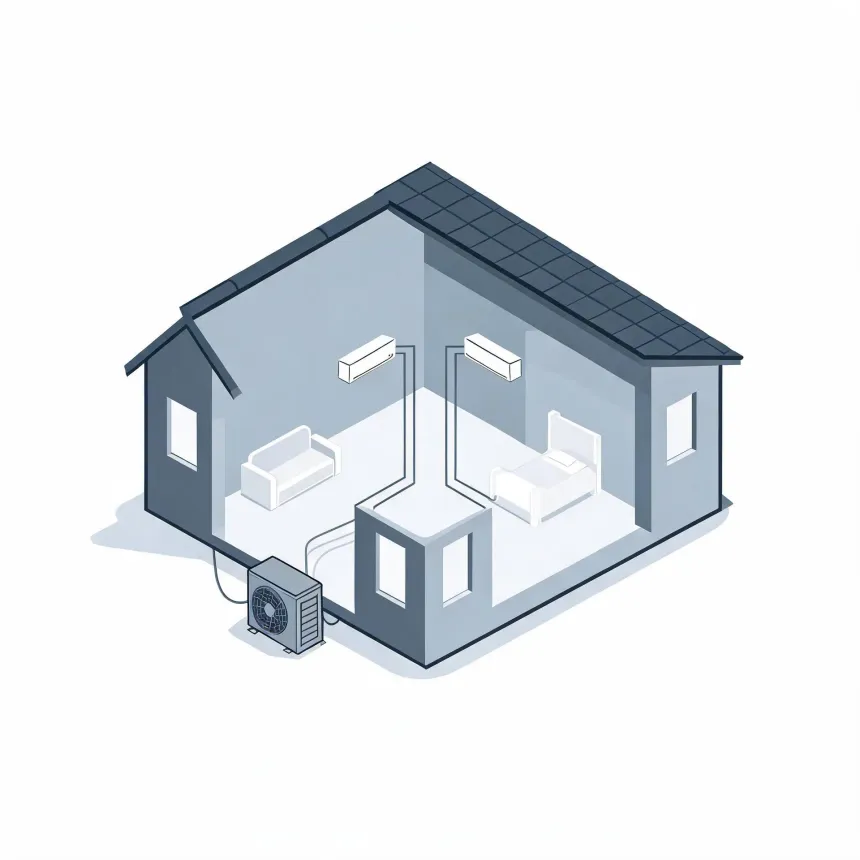
- A single indoor head warms or cools one room or one open area well. If you need more than that, a multi-zone system lets one outdoor unit run several indoor heads, each with its own thermostat, so you can cover more rooms at once. A contractor sizes the system to the square footage and layout of the house, since guessing on capacity leaves rooms too warm or too cold.
- Can a mini split heat a whole house?
- It can, if the system has enough indoor heads and enough outdoor capacity to match the house, but that takes real planning, not one unit in the living room. With heat needed here from September through June and lows near 12°F in the winter, a cold-climate mini split system is worth asking about specifically, since standard heat pumps lose capacity in that kind of cold. A contractor can lay out how many zones your house needs to heat every room.