Mini Split Installation in Cheyenne, WY
A new system here will heat from September through May and cool from July through August every year. Tell us about the house, and a licensed contractor who covers Laramie County will get in touch.
Tell us about the job
It takes about a minute.
What a mini-split needs to handle in Cheyenne
Your mini-split runs nearly the whole year in Laramie County. Homes here need heat from September through May, then cooling in July and August, so the system is doing one job or the other 11 months out of the year.
Winter nights average 16°F, so this has to be a heat pump built to keep heating at that temperature, not a cooling-only unit. Summer afternoons average 82°F, so it has to be sized for that heat load too. Any unit made now has to meet 14.3 SEER2 for cooling and 7.5 HSPF2 for heating, the federal minimum for split-system heat pumps. Cheyenne also sees frequent winter storms and high wind, so it is worth asking whether the system you choose starts back up on its own once power is restored.
- 9 months
- September through May, your system heats
- 2 months
- July through August, it cools
- 16°F
- the average winter night it heats against
- 82°F
- the average summer afternoon it cools against
NOAA nClimDiv, 1991–2020 normals
- Is a mini split worth it?
- For most homes here, yes, but it depends on what you need it to do. A mini split heats and cools the same space without ducts to lose air through, so it runs efficiently in a room or an addition. Cheyenne winters push down to 16°F on average from December through February, and a mini split's output drops as the temperature drops, so ask about the unit's rated output at low temperatures before you count on it as your only heat source. If you're adding comfort to one or two rooms, or replacing electric baseboard heat, it's usually worth it. A contractor can size it to your house and tell you what to expect.
- How many rooms can a mini split cover?
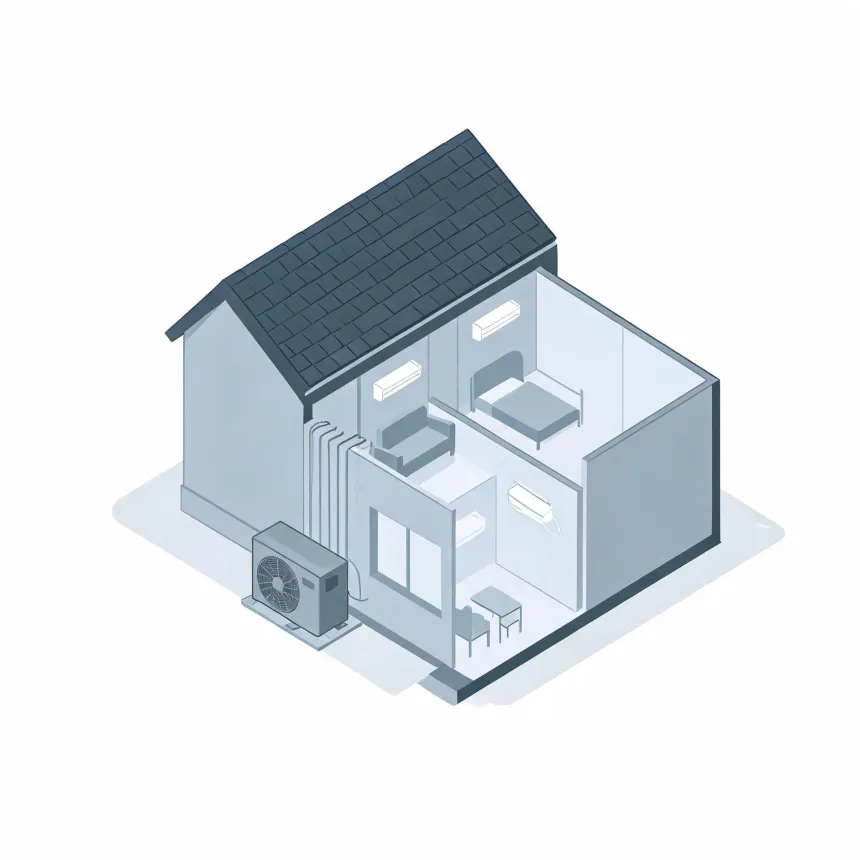
- A single indoor unit is built for one room or one open area. If you need to cover several rooms, you'd use a multi-zone system, which connects one outdoor unit to several indoor heads, each with its own thermostat. How many zones an outdoor unit can run depends on the manufacturer and the size of the unit. A contractor can walk the house and tell you how many zones it actually needs.
- Can a mini split heat a whole house?
- It can, but it takes the right setup, not just one indoor unit. A whole-house system uses multiple indoor heads, one for each room or zone, all connected to an outdoor compressor sized for the whole load. In Cheyenne, where winter nights average 16°F from December through February, the outdoor unit has to be rated to keep producing heat at those temperatures, since output on any heat pump drops as it gets colder outside. Homes here need heat from September through May, so that low-temperature performance matters more than it would somewhere milder. A contractor can calculate the heating load for your house and tell you whether a mini split system covers it on its own or works alongside your existing furnace.