Mini Split Installation in Laramie, WY
Tell us about the house, and a licensed contractor who covers Albany County will get in touch.
Tell us about the job
It takes about a minute.
A mini-split in Laramie is running a heating machine, not a cooling one
Winter nights here average 13°F, and homes need heat from September through June. That is ten months a year the system is expected to work, and only a few weeks in between when it isn't. A mini-split installed here has to be sized and set up for long, cold winters first. Cooling barely enters into it.
The unit itself has to meet a federal minimum either way. Since January 2023, split-system heat pumps, which is what a mini-split is under that standard, must reach at least 7.5 HSPF2 for heating and 14.3 SEER2 for cooling. In a place where the heating side does nearly all the work, that heating rating matters more than the cooling one ever will.
- 10 months
- September through June, your system heats
- 13°F
- the average winter night it heats against
- 76°F
- the average summer afternoon it cools against
- Is a mini split worth it?
- For most homes here, yes, if the goal is heat. A mini split heat pump pulls heat from outside air even when it's cold, and cold-climate models keep working well below freezing. With winter lows here averaging 13°F, look for a unit rated for cold-climate performance, and ask the contractor what output it holds at that temperature. Homes here need heat ten months of the year, so the heating side matters more than the cooling side.
- How many rooms can a mini split cover?
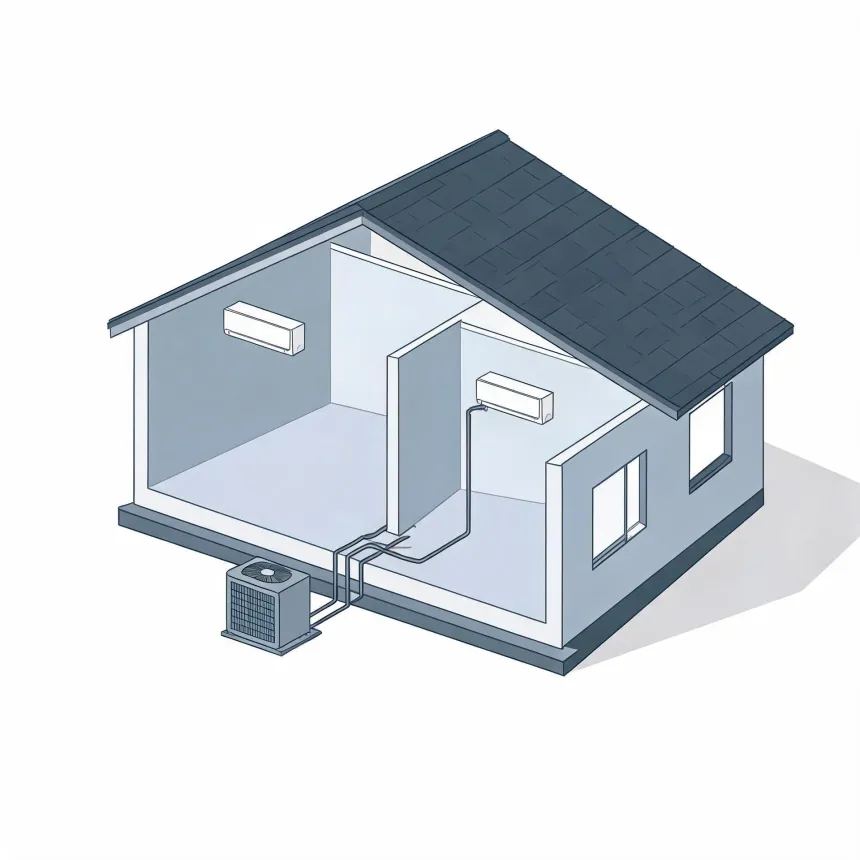
- A single outdoor unit can run one indoor head or several, depending on the system. Single-zone systems serve one room or open area. Multi-zone systems split the output of one outdoor condenser across two to eight indoor heads, each with its own thermostat. The more zones on one outdoor unit, the less heating and cooling capacity is available to any single room, so a contractor sizes the system room by room rather than just adding up square footage.
- Can a mini split heat a whole house?
- It can, but it depends on the layout and how many heads the house needs. A ducted or multi-zone mini split can serve every room if each space gets its own indoor head or a duct run sized for it. A single indoor unit will heat the room it's in and whatever space is open to it, but it won't push heat through closed doors or down a hallway on its own. With winter nights here averaging 13°F, a contractor will also check that the outdoor unit is sized and rated to keep up at that temperature before calling it a whole-house solution.