Mini Split Installation in Douglas, WY
A new system here will heat from September through June and cool from July through August every year. Tell us about the house, and a licensed contractor who covers Converse County will get in touch.
Tell us about the job
It takes about a minute.
Ten months of heat, two months of cooling
A mini-split in Douglas spends most of the year on heat, not cooling. Winter nights average 14°F from December through February, and the heat pump side has to keep working through that cold for ten months straight, September through June. Summer only asks two months of it, with afternoons averaging 82°F.
Any new mini-split has to meet the federal minimum for split-system heat pumps, 7.5 HSPF2 for heating and 14.3 SEER2 for cooling. With winters this long and this cold, the heating number is the one that matters most here.
- 10 months
- September through June, your system heats
- 2 months
- July through August, it cools
- 14°F
- the average winter night it heats against
- 82°F
- the average summer afternoon it cools against
NOAA nClimDiv, 1991–2020 normals
- Is a mini split worth it?
- For most homes it comes down to what you're heating or cooling and how the space is set up now. A mini split gives you heat and air conditioning from one system, without ductwork, and it controls each room separately so you're not conditioning space nobody's using. Down to 14°F on a winter night here, a cold-climate heat pump is built to keep producing heat, but check that the model you're considering is rated for that kind of cold. A contractor can walk the house and tell you whether it fits your situation.
- How many rooms can a mini split cover?
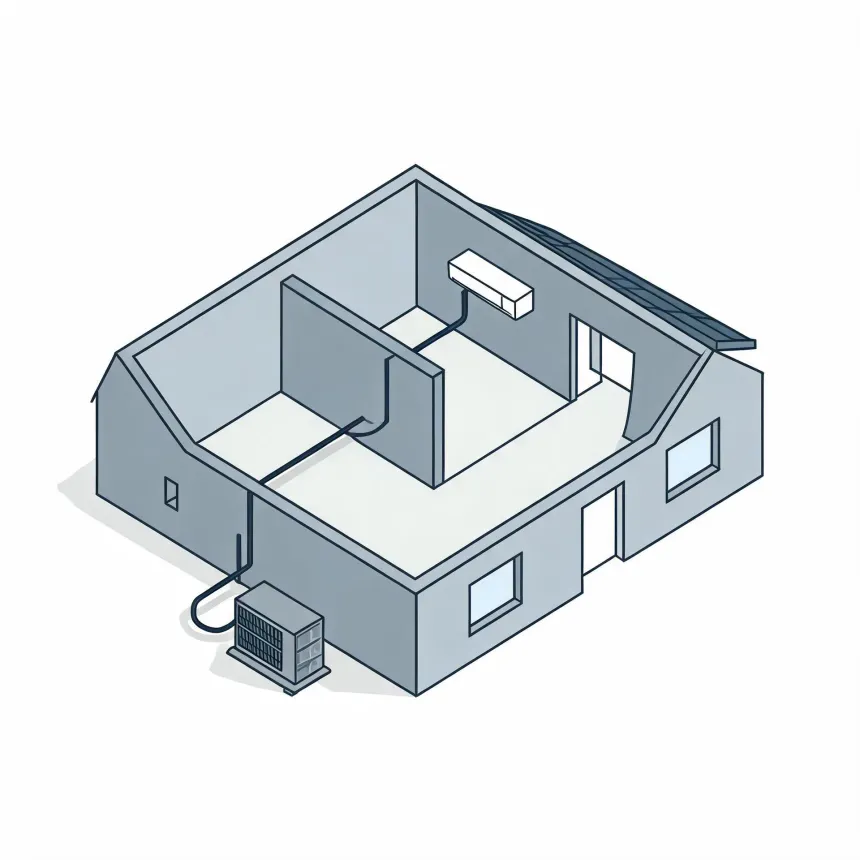
- A single outdoor unit can run one indoor head or several, depending on the system. A single-zone system heats and cools one room. A multi-zone system connects one outdoor unit to several indoor heads, each with its own thermostat, so different rooms can run at different temperatures. How many heads one outdoor unit can carry depends on its capacity and the size of the rooms, so a contractor needs to look at the house before saying how many it can support.
- Can a mini split heat a whole house?
- It can, if it's sized and placed for that. A whole-house setup means enough indoor heads to reach every room that needs heat, matched to an outdoor unit with the capacity to run all of them, and rated to keep working at the cold you actually get. Winters here run cold enough, down to 14°F on average, that the equipment has to be chosen for that specifically. A contractor can size a system against the house and tell you what it would take to cover it all.