
Signs your furnace is undersized for a Wyoming home
A local installer who puts in furnaces gets your project.
Match me with a proA furnace that runs nonstop on the coldest Wyoming days, never quite reaching the temperature on the thermostat, or leaves rooms far from it cold, is too small for the house. Furnaces are sized to the heat loss of a home on its coldest expected night, and Wyoming winters push well below zero in most of the state. A furnace sized for a milder climate, or for a smaller house than the one it ended up in, has to run longer and harder to keep up, and on the worst nights it still won't catch up. You might also notice the furnace short cycling in milder weather and running flat out in the cold, or the flame sensor and igniter wearing out faster because the unit rarely gets to rest. If your gas bill climbs faster than the temperature drops, that's the furnace working past what it was built to do, not just winter being winter.




Is Your Furnace Big Enough
Undersized
- The furnace runs through the entire night on a sub-zero night and the house still sits a few degrees under the thermostat setting.
- Rooms at the far end of the ductwork, or above an attached garage, stay noticeably colder than the room with the thermostat.
- The blower seems to run almost all the time from December through February instead of cycling off once the house reaches temperature.
- Ice or frost builds up on windows in the coldest rooms because the glass is losing heat faster than the furnace is replacing it.
- A single cold snap in the teens or lower pushes the system to its limit even though it handled a mild December fine.
- The thermostat shows a gap of several degrees between what it's set to and what a room thermometer reads in the back bedrooms.
Correctly sized
- The furnace cycles off at some point even on the coldest night of the year, meaning it reached the set temperature and shut down.
- Every room in the house lands within a degree or two of the thermostat setting, including rooms far from the return air duct.
- The blower runs for a stretch, shuts off, and stays off for a while before the next cycle starts, even in January.
- Windows in bedrooms and living areas stay clear of frost because the rooms are holding the heat the furnace is putting out.
- A hard freeze doesn't change how the system behaves day to day, it just runs its normal cycles a little more often.
- Set the thermostat to 68 and a room thermometer in any part of the house reads close to 68, not several degrees off.
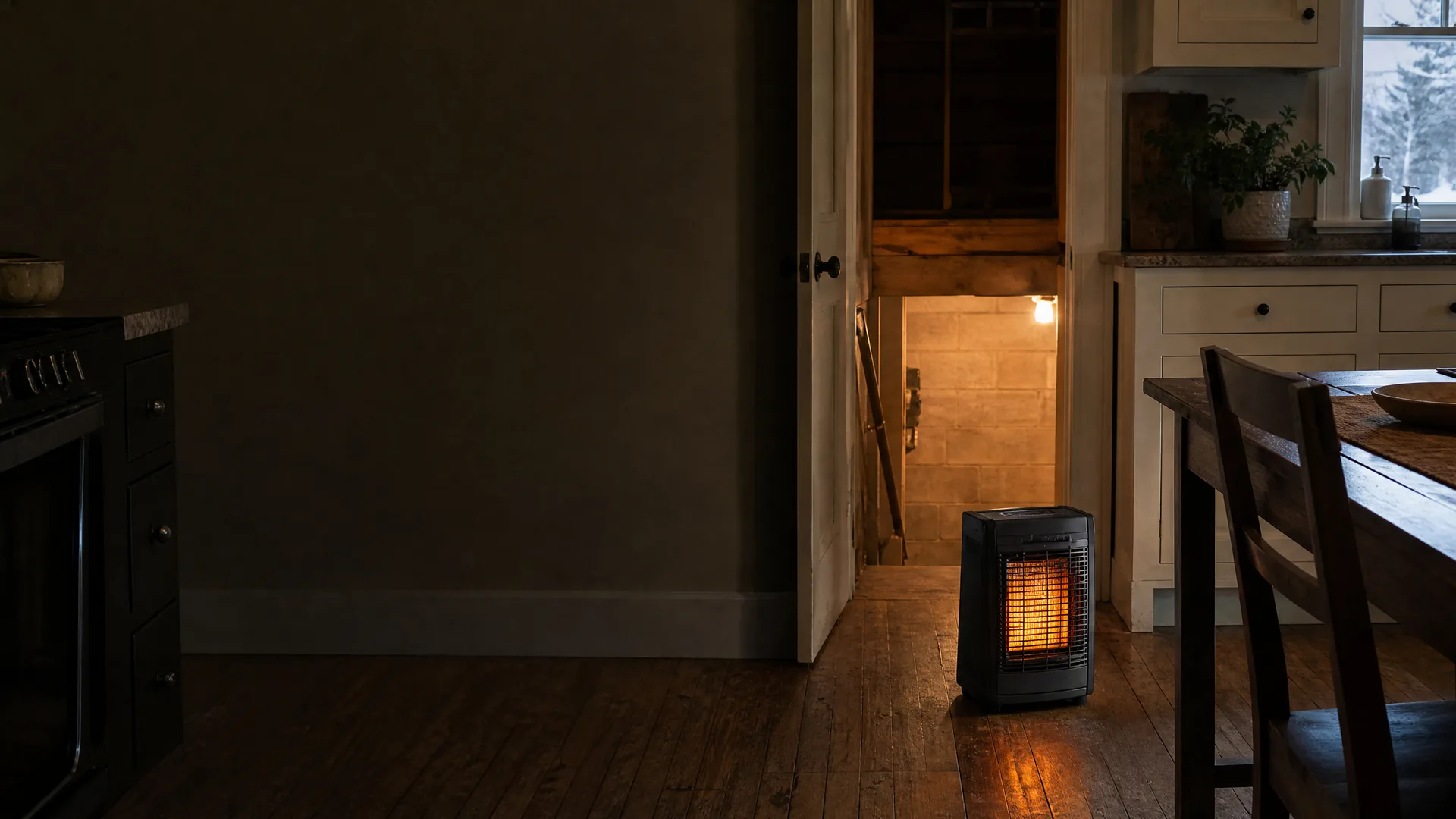
The thermostat still reads sixty-four. It's just past six and the sky outside the kitchen window is that flat gray before sunrise. You've got the space heater pulled out from the hall closet again, set up by the table, the orange coil glowing while you wait on coffee. The basement door is open behind it, you went down twenty minutes ago to check the furnace, listen to it run, make sure it hadn't quit. It hadn't. It just wasn't keeping up. Outside it's well below zero, the kind of morning that shows you exactly what your furnace can and can't do. You already know what the next call needs to be about. You just haven't made it yet.
A pro who works on furnaces

Send the form and the search for an installer is over.
It costs nothing to send, and you don't have to hire anyone.
How Sizing Actually Works
- A furnace is sized by a heat loss calculation, matching its output in BTUs to how fast your house loses heat at design temperature.
- Wyoming's design temperature, the coldest night a furnace is expected to handle, sits well below zero in most counties.
- An undersized furnace runs at full fire almost constantly, which wears the blower motor and burners faster than a furnace that cycles normally.
- The furnace nameplate lists input and output BTUs, and a contractor compares that output against the square footage and insulation of your home.
- Furnaces are built in fixed output sizes, so a replacement often has to round up to the next size rather than match the old one exactly.
- A furnace that cycles on and off every few minutes even in mild weather is usually oversized, not undersized, for the house it's in.
Sizing a furnace starts with a heat loss calculation. A contractor works out how fast a house loses heat through its walls, windows, and roof at the local design temperature, then matches a furnace's output in BTUs to that number. In most Wyoming counties, the design temperature used for that math sits well below zero, which is part of why furnaces here carry more capacity than the same size house would need in a milder state. The nameplate on the furnace lists two numbers, input and output BTUs. Input is the gas it burns, output is the heat it actually delivers after combustion losses, and a contractor weighs that output figure against the square footage and insulation of the house, not against the old furnace's age or what the last owner had installed. Furnaces don't come in custom sizes. They're built in fixed steps, so when one gets replaced, the next size up is often the closer match rather than an exact repeat of what's being pulled out. Running at full fire constantly to chase a cold night puts more wear on the blower motor and burners than normal cycling does, since those parts were built around turning on, reaching temperature, and shutting off, not running flat out for hours at a stretch. Short-cycling, where the furnace fires and stops every few minutes even when it's mild outside, points the other way, toward a furnace too large for the house rather than too small.
Winter nights average 13°F statewide
That 13°F average includes the mild nights. On the hard cold snaps your furnace has to work well past that, and a unit sized too small shows it fastest on those nights, running long and losing ground.
NOAA nClimDiv 1991-2020 county normals weighted by homes

A furnace that can't keep up tells you plainly
You've got the signs now. A thermostat that never reaches its setting on the coldest nights. Rooms that stay cold no matter how long the furnace runs. A system that's working harder than it should and still losing ground. If that's your house, the furnace is undersized for what a Wyoming winter asks of it, and no amount of adjusting the thermostat changes that.
The next step isn't figuring out the right size on your own. A heat loss calculation for your specific house, done by someone who knows how to run one, settles it. Send in what you've noticed and a contractor who handles this in your area will follow up directly, looking at your house and your ductwork, not a general rule. That part stops being something you have to sort out alone.



Furnace Installation
Get your furnace to the right pro
Send the request and finding a pro stops being your problem.
